
Nissan Rogue AWD Error: Causes & Fixes
The AWD warning just lit up on your Rogue’s dash. If you’re like most owners, it caught you off guard, and now you’re a little worried something expensive just broke.
Most of the time, it hasn’t. The Rogue usually keeps driving in front-wheel drive, and the cause is often simple: a tire that doesn’t match the other three, or a system that got too hot.
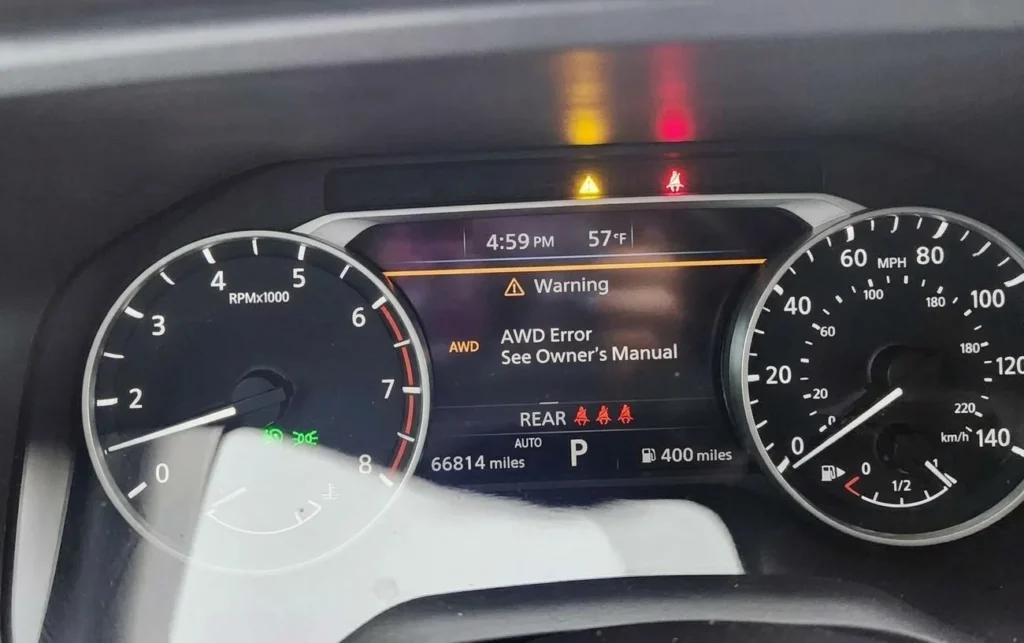
Here’s how to figure out which one you’re dealing with.
Quick answer: The AWD warning light means the Rogue’s all-wheel-drive system has detected a problem and may switch to front-wheel drive to protect itself. The most common triggers are mismatched or unevenly worn tires, an overheated AWD system (often after being stuck), low battery voltage, a faulty wheel speed sensor, or a failing rear coupling. Reduce speed, check your tires, and have a Nissan dealer scan the system if the light stays on.
What the AWD Warning Light Means
Every AWD Rogue uses a front-biased system. Most of the time, power goes to the front wheels. When the car senses slip, an electronically controlled coupling at the rear axle sends torque to the back wheels.
The AWD warning light is how that system tells you something’s off.
When you first turn the ignition on, it’s normal for the light to come on briefly. It should go out soon after the engine starts. If it comes on while driving, Nissan’s owner’s manual says there may be a malfunction in the AWD system. The advice is to reduce speed and have the vehicle checked by a Nissan dealer as soon as possible.
When the system detects a fault, it typically falls back to front-wheel drive. The car still drives. You just lose the rear-wheel help.
Solid vs. Blinking Light
Older Rogue manuals describe three different light behaviors. Each one points to a different issue:
| Light behavior | What it usually means | What to do |
|---|---|---|
| Stays on (solid) | AWD system malfunction | Reduce speed, get the system scanned by a dealer |
| Blinks quickly (about twice per second) | Powertrain oil is too hot, usually after trying to free a stuck vehicle. The system may switch to 2WD | Stop in a safe place, let it idle and cool down |
| Blinks slowly (about once every 2 seconds) | Big difference in front vs. rear wheel diameters | Check tire size, pressure, and wear |
AWD Messages on 2014 and Newer Rogues
From the 2014 model year, the Rogue also shows AWD messages in the vehicle information display, alongside the master warning light. Here’s what they mean, based on the owner’s manual:
| Message | What it means | What Nissan says to do |
|---|---|---|
| All-Wheel Drive (AWD) Error – See Owner’s Manual | The AWD system has detected a fault | Contact a Nissan dealer |
| All-Wheel Drive (AWD) High Temp. Stop Vehicle | The AWD system is overheating | Stop in a safe place with the engine idling. The system may switch to 2WD. If the warning goes off, you can drive again |
| All-Wheel Drive (AWD) Tire Size Incorrect – See Owner’s Manual | The system sees a difference in tire diameters | Pull over safely. Check that all tires are the same size, pressure is correct, and tires aren’t worn |
Common Causes of the AWD Warning Light
1. Mismatched or Unevenly Worn Tires
The AWD system constantly compares wheel speeds. If one tire is a different size, or much more worn than the others, it spins at a slightly different speed. The system reads that as slip, keeps engaging the coupling, and eventually flags a problem.
That mismatch usually comes from replacing only two tires, driving too long on the compact spare, one tire running low on air, or mixing brands whose actual diameters differ.
A common guideline for AWD vehicles is to keep all four tires within about 2/32 inch of tread depth of each other. If you just bought two new tires and the light showed up right after, that’s very likely your answer.
A quick note from me: To be upfront, my own Rogue is a front-wheel-drive model. My AWD lesson came from a Honda Pilot.
Back then, I didn’t really understand tire rotation or what skipping it could do. I didn’t rotate the tires, and one of them (the front left, if I remember right) wore out much faster than the rest. I had to replace it early. The other three were still in good shape, so I replaced just that one.
I didn’t know it then, but that’s exactly the kind of tread mismatch an AWD system doesn’t like. Now I rotate the tires on AWD cars every 5,000 miles. Wear stays even, all four get replaced together, and the tread depth stays matched.
Want to double-check your wheel and tire setup? See our guide on the Nissan Rogue bolt pattern and the correct Nissan Rogue lug nut torque.
2. AWD System Overheating
If you’ve been spinning the wheels in snow, mud, or sand trying to get unstuck, the coupling works hard and heats up fast.
When that happens, the light blinks quickly (older models) or you’ll see the “AWD High Temp” message (2014+). The system switches to front-wheel drive to protect itself.
This one usually fixes itself. Stop, let the engine idle, and give it a few minutes. Once it cools, the warning should clear.
On 2008–2020 Rogues with the AWD LOCK button, there’s one more thing to keep in mind. Nissan warns never to drive on dry, hard roads in LOCK mode. It can overload the powertrain and cause a serious malfunction. Lock mode is for getting moving on slippery surfaces only.
Curious how the different modes work? Check out our Nissan Rogue drive modes guide.
3. Low or Weak Battery
The AWD control unit relies on stable voltage and on data from other modules over the car’s network. When the 12-volt battery is weak, modules can drop communication and throw random warnings. The AWD light often shows up together with other lights at the same time.
Transmission and drivetrain specialists say the same thing: check battery condition first, because low or erratic voltage can and will interfere with AWD operation.
If the AWD light showed up with several other warnings after a cold morning or a jump-start, test the battery before anything else.
4. Faulty Wheel Speed Sensor or ABS Issue
The AWD system uses wheel speed data from the ABS sensors. If one sensor fails, gets dirty, or has a damaged wire, the AWD system loses the information it needs.
The clue here is usually multiple lights together: AWD, ABS, VDC (stability control), and sometimes the SLIP light.
A scan tool will usually point straight to the bad sensor. The sensor itself is a fairly common, affordable repair.
5. Water-Damaged Wiring Under the Driver’s Footwell (2014–2016 Recall)
Nissan recalled 621,709 2014–2016 Rogues (built July 25, 2013 to December 31, 2016) under NHTSA recall 22V-024. Water and road salt can collect in the driver’s footwell and wick into a wiring connector. That causes corrosion.
Besides the AWD warning light, the recall documents list a dead driver’s power window or power seat, battery drain, and in worse cases a burning smell or smoke under the driver’s side dash.
Dealers inspect the connectors and replace them if corrosion is found, free of charge. If you own a 2014–2016 Rogue with an AWD light, check your VIN at nhtsa.gov/recalls before paying for any diagnosis.
6. Failing AWD Control Module
On first-gen Rogues (2008–2013), the AWD control module is another known weak spot. Water intrusion into the driver’s footwell, often from clogged A/C drains or poorly sealed seams, can corrode the module.
A common trouble code here is U0102 (lost communication with the transfer case control module). Replacement modules often need dealer programming, so it isn’t always a simple plug-and-play swap.
7. Worn Rear Coupling or Low Fluid
The electronically controlled coupling at the rear axle is the heart of the Rogue’s AWD. Nissan has issued several service bulletins about it:
- NTB20-069 (2015 Rogue and Rogue Sport): rear vibration or judder in low-speed turns on dry roads. The fix may include replacing the AWD control unit and the rear coupling.
- NTB23-051 (2021–2023 Rogue AWD): a binding feeling, vibration, or noise from the rear when turning at low speed. The fix is replacing the AWD coupler.
- A broader bulletin covers rear differential noise, vibration, or judder on 2008–2022 Rogues and 2017–2022 Rogue Sports. Nissan tells technicians to replace the coupling first, not the whole rear differential.
If your AWD light comes with a shudder, groan, or binding feeling when turning into a parking spot, mention these bulletins to your service advisor.
Fluid matters here too. Nissan’s maintenance schedule includes inspection of the differential, transfer case, and (on newer models) coupling oil for AWD Rogues. Skipping these over many years puts extra strain on the system.
How to Fix the AWD Warning Light
Work through these steps in order. They go from free and easy to dealer-level.
Step 1: Note how the light behaves. Solid, fast blink, or slow blink? Any message on the screen? Any other lights on? This tells you where to start.
Step 2: Let it cool down. If you were stuck or spinning the tires, stop somewhere safe and let the engine idle. If the light goes out, you’re good to go.
Step 3: Check all four tires.
- Same size on all four (check the sidewall)
- Correct pressure (see the label on the driver’s door jamb)
- Similar tread depth, ideally within about 2/32 inch
- Spare tire not installed
Step 4: Check the battery. Have it load-tested at a parts store or shop. Clean and tighten the terminals. A weak battery causes many “ghost” warnings.
Step 5: Check for open recalls. Enter your VIN on the NHTSA recall site. This is especially important for 2014–2016 models.
Step 6: Scan for trouble codes. A basic code reader won’t always see AWD or ABS codes. A scanner that reads chassis (C-codes) and network (U-codes) is better. A Nissan dealer’s CONSULT tool gives the full picture.
Step 7: Repair what the codes point to. That might be a wheel speed sensor, wiring, the AWD control unit, or the rear coupling. Some parts need programming after replacement, so the coupling and control module are usually dealer jobs.
Tip: Turning the car off and on may clear the light for a while. But if the cause is still there, it’ll come back. Don’t treat a reset as a fix.
Is It Safe to Drive With the AWD Light On?
In most cases, yes, for a short time. When the AWD system detects a problem, it usually switches to front-wheel drive. The Rogue will still steer, brake, and drive normally on dry roads.
You do lose the rear-wheel help, though. So go easier in rain, snow, or on gravel, and keep your speed down. That’s Nissan’s own advice when the light comes on while driving.
A “High Temp” warning means stop and let it cool. Grinding, binding, or judder from the rear means book a check soon. And a burning smell or smoke under the dash means stop driving altogether. On 2014–2016 models, that’s tied to the wiring recall.
Driving for weeks with mismatched tires or a dragging coupling can turn a cheap fix into a costly one.
How to Prevent AWD Problems on Your Rogue
- Replace tires as a set of four whenever you can
- Rotate tires on schedule so they wear evenly
- Keep tire pressures equal and correct
- Don’t drive long distances on the compact spare
- Use AWD LOCK (2008–2020 models) only on slippery surfaces
- Keep the driver’s footwell dry, and check that A/C drains aren’t clogged
- Follow Nissan’s schedule for differential, transfer case, and coupling oil
- Replace a weak battery before winter
Taking care of the drivetrain as a whole matters too. Our Nissan Rogue transmission fluid guide covers the CVT side of the system.
Frequently Asked Questions
The Rogue uses an all-wheel-drive system on AWD trims, not a traditional 4WD with a low range. We break down the difference in Does the Nissan Rogue Have 4WD?
Most likely because the new tires have a larger diameter than the older ones still on the car. The AWD system reads the speed difference as slip. Replacing all four tires, or matching tread depth, usually solves it.
Yes. Low or unstable voltage can disrupt communication between modules. That often triggers the AWD light along with several other warnings.
If the cause was overheating, yes. It should go out once the system cools. For other causes, the light usually comes back until the underlying problem is fixed.
These systems share wheel speed data. A faulty wheel speed sensor or ABS problem can trigger all three at once.
Bottom Line
Start with what’s free: let it cool, check your tires, test the battery, and look up recalls. If the light keeps coming back after that, get the system scanned. Replacing parts on a guess is how a simple tire problem turns into an expensive repair.

Tristan has been deep in the automotive world since 2014, long before NissanRogueInfo.com started. His interest in the Rogue actually goes back to high school when he saw a first-gen model modified for off-roading—a moment that stuck with him ever since.
With a Bachelor of Technology and over a decade of professional car journalism under his belt, Tristan doesn’t just write about specs; he’s usually the one under the hood of his own Nissan Rogue or Honda CR-V, figuring out DIY fixes and maintenance tricks. He built this site to share that hands-on experience with other SUV owners who want practical, no-nonsense advice.