
Nissan Rogue Towing Capacity (All Model Years & Trims)
The Nissan Rogue can tow up to 1,500 lbs on 2022–2026 models. Older Rogues tow less. Some are rated as low as 1,000 lbs.
That’s enough for a small utility trailer, a kayak trailer, or a single jet ski. It’s not enough for a family camper or a boat.
Below you’ll find the rating for every model year, what changes it, and what you can realistically pull.
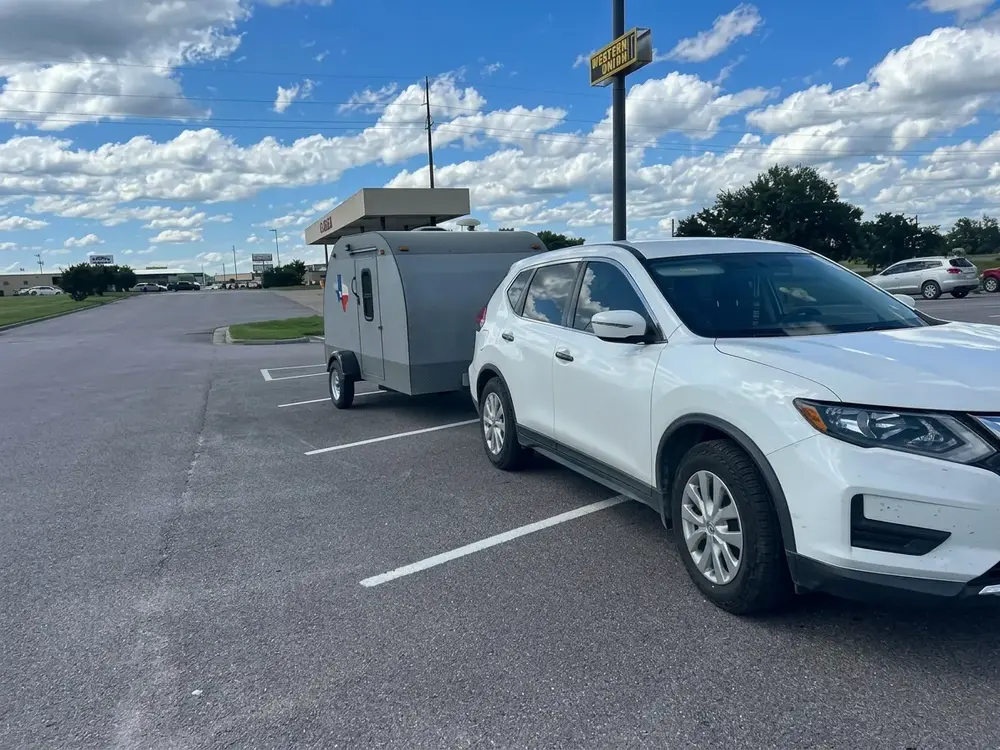
Nissan Rogue Towing Capacity at a Glance
| Generation | Model Years | Max Towing Capacity | Engine |
|---|---|---|---|
| Third gen (VC-Turbo) | 2022–2026 | 1,500 lbs | 1.5L VC-Turbo 3-cyl, 201 hp |
| Third gen (first year) | 2021 | 1,350 lbs | 2.5L 4-cyl, 181 hp |
| Second gen | 2014–2020 | About 1,100 lbs (1,000 lbs on some years) | 2.5L 4-cyl, 170 hp |
| First gen | 2008–2013 | 1,000–1,500 lbs (varies by year and trim) | 2.5L 4-cyl, 170 hp |
FWD and AWD models share the same rating. In most years, so do all the trims. More on that below.
Nissan Rogue Towing Capacity by Model Year
2022–2026 Nissan Rogue: 1,500 lbs
Nissan swapped the 2.5L four-cylinder for the 1.5L VC-Turbo three-cylinder in 2022. Power went up to 201 hp and 225 lb-ft of torque. The tow rating went up with it.
Nissan’s own spec sheets for the 2024 and 2026 Rogue list 1,500 lbs of trailer weight and 150 lbs of tongue weight.
| Model Year | Towing Capacity | Tongue Weight |
|---|---|---|
| 2026 | 1,500 lbs | 150 lbs |
| 2025 | 1,500 lbs | 150 lbs |
| 2024 | 1,500 lbs | 150 lbs |
| 2023 | 1,500 lbs | 150 lbs |
| 2022 | 1,500 lbs | 150 lbs |
2021 Nissan Rogue: 1,350 lbs
The 2021 Rogue was the first year of the current generation. It still used the older 2.5L four-cylinder (181 hp). Nissan rated it at 1,350 lbs, with a max tongue weight of 134.9 lbs.
The VC-Turbo didn’t arrive until 2022.
2014–2020 Nissan Rogue: About 1,100 lbs
The second-generation Rogue is rated at roughly 1,100 lbs (500 kg). Max tongue weight is about 110 lbs.
| Model Year | Towing Capacity |
|---|---|
| 2020 | 1,100 lbs |
| 2019 | 1,100 lbs |
| 2018 | 1,100 lbs |
| 2017 | 1,100 lbs |
| 2016 | 1,100 lbs |
| 2015 | 1,100 lbs |
| 2014 | 1,100 lbs |
Nissan also sold the Rogue Select in 2014 and 2015. That’s the older first-gen body sold alongside the new one. It’s rated at 1,000 lbs.
2008–2013 Nissan Rogue: 1,000–1,500 lbs
The first-gen Rogue is where it gets confusing. The rating depended on the year and the trim.
| Model Year | Towing Capacity | Notes |
|---|---|---|
| 2011–2013 | 1,000 lbs (S) / 1,500 lbs (SV, SL) | Base S trim is capped lower |
| 2008–2010 | Up to 1,500 lbs | Varies by configuration |
If you own one of these older Rogues, check the owner’s manual for your exact year before you tow anything near the limit.
Does Trim Level Change the Rogue’s Towing Capacity?
Mostly, no.
Nissan’s spec sheets for the 2021, 2024 and 2026 Rogue each list a single towing number for the whole lineup. That covers S, SV, SL, Rock Creek, Dark Armor and Platinum, depending on the year. Trim changes your features, not your tow number. FWD and AWD share the same limit too.
The exception is the older 2011–2013 Rogue. The base S was rated 1,000 lbs. The other trims got 1,500 lbs.
So if you’re buying a Rogue to tow, pick the trim you like. Just make sure it’s a 2022 or newer if you want the full 1,500 lbs.
Tongue Weight and Trailer Brakes
Two numbers matter as much as the headline rating.
Tongue weight. This is the downward force the trailer puts on the hitch. Nissan lists 150 lbs for the 2024 and 2026 Rogue, and 134.9 lbs for the 2021. The general rule is 10–15% of the trailer’s weight. Tongue weight also counts against your payload.
Trailer brakes. Nissan’s owner’s manual for the second-gen Rogue says any towing above 1,000 lbs requires trailer brakes. Since most trailers near the Rogue’s limit weigh more than that, plan on brakes. Check the manual for your model year.
What Can a Nissan Rogue Tow?
Keep the total (trailer plus cargo) under the limit. Here are realistic examples. Weights are approximate.
- Small utility trailer (5×8) with light cargo: yes
- Kayak or canoe trailer: yes, easily
- Motorcycle trailer with one bike: usually, check the combined weight
- One jet ski on a trailer: often close to the limit, weigh it first
- Teardrop trailer or small pop-up: only the lightest ones
- Travel trailer, boat, or horse trailer: no
Remember the rating assumes only a driver in the car. Add passengers and gear, and your real margin shrinks.
What You Need to Tow With a Rogue
The Rogue doesn’t come with a factory tow package on most trims. You’ll need to add:
- A Class I hitch receiver
- A 4-pin wiring harness
- A ball mount and hitch ball
- Safety chains
- A trailer brake controller if the trailer has electric brakes
Nissan sells these as genuine accessories. A weight-distributing hitch isn’t needed at this weight.
Towing With the Rogue’s CVT
Every Rogue uses a CVT. CVTs don’t like heat, and towing makes heat.
A few basics that apply to any Rogue owner:
- Make sure the CVT fluid is fresh and the correct type before you start towing regularly
- Keep trips short and speeds moderate
- Skip long, steep climbs with a loaded trailer
- Stop and let it cool if you notice slipping or a burning smell
If you tow often, shorten your CVT fluid service interval. It’s cheap insurance for an expensive part.
Nissan Rogue vs. Other Compact SUVs
Most compact SUVs sit in the same range. Ratings vary by year and trim.
| SUV | Typical Max Towing |
|---|---|
| Nissan Rogue (2022+) | 1,500 lbs |
| Honda CR-V | 1,500 lbs |
| Subaru Forester | 1,500 lbs (higher on some trims) |
| Hyundai Tucson | Up to 2,000 lbs |
| Mazda CX-5 | Up to 2,000 lbs |
The Rogue sits in the middle of the pack. If you need more, look at a midsize SUV like the Honda Pilot or Nissan Pathfinder instead.
Nissan Rogue Towing Capacity FAQ

Tristan has been deep in the automotive world since 2014, long before NissanRogueInfo.com started. His interest in the Rogue actually goes back to high school when he saw a first-gen model modified for off-roading—a moment that stuck with him ever since.
With a Bachelor of Technology and over a decade of professional car journalism under his belt, Tristan doesn’t just write about specs; he’s usually the one under the hood of his own Nissan Rogue or Honda CR-V, figuring out DIY fixes and maintenance tricks. He built this site to share that hands-on experience with other SUV owners who want practical, no-nonsense advice.