
Nissan Rogue Coolant Guide (All Model Years)
When a car engine overheats, it’s certain to cause serious damage. To fix it, in most cases you’ll have to overhaul the engine, and that doesn’t come cheap!
The cheapest way to deal with overheating is to prevent it. To do this, you need to pay close attention to your car’s coolant.
Coolant is one of the most important fluids in a car; it’s part of the cooling system that prevents overheating. Checking and changing the coolant in your Nissan Rogue is all part of regular maintenance.
In this guide, I’ll explain why coolant plays such a vital role in a car’s engine and show you how often it should be replaced. I’ll also list the coolant capacity for each model year of the Nissan Rogue to make it easier for you to plan your maintenance.
Let’s get started!
About Coolant
As I mentioned earlier, coolant is a fluid designed to prevent a car from overheating.
Coolant is often also called antifreeze, even though the two are different terms.
- Antifreeze: This is a concentrated liquid used as the base for making coolant, typically made from ethylene glycol or propylene glycol. To use it, it must be mixed with water in a specific ratio.
- Coolant: This is a ready-to-use cooling fluid. No additional ingredients need to be mixed in.
Coolant is a mixture of antifreeze and water, typically in a 50-50 ratio. This mixture is ideal for use in a variety of conditions, as it prevents water from freezing down to 30 degrees Fahrenheit below zero and prevents water from boiling up to 223 degrees. In fact, with a properly functioning radiator cap, the pressure in the radiator system is maintained, which can raise the coolant’s boiling point even higher, up to around 260 degrees.
However, if you’re driving in extremely cold climates, a 70% antifreeze mixture may be necessary.
Using plain water instead of coolant won’t cool the engine properly. Plain water boils at 212 degrees and freezes at 32 degrees.
If overheating occurs, it can warp engine parts, which is really bad. On the other hand, without antifreeze, water will freeze in the cooling system during winter; when it freezes, the water expands and damages the engine block and cooling system components. That’s even worse. LOL
In addition, coolant offers other benefits besides optimizing cooling performance. Here are a few of them:
- Prevents corrosion in the radiator and heating system
- Extends the life of the cooling system hoses
- Prevents scale buildup in the radiator
Coolant absorbs heat from the engine and directs it to the radiator, where it is dissipated by fresh air, then recirculates through the engine again.
(cars)
Checking the Level
Checking the coolant level is very easy, but most people often overlook this simple step.
It’s a good idea to make sure the coolant is always at the proper level. If the coolant is low, you might notice the temperature gauge rising toward the “H” (Hot) zone.
The engine coolant temperature gauge is marked with a thermometer submerged in water.
If the temperature gauge turns red, it means the engine is overheating, and serious damage could occur. That’s why you want to ensure there’s enough coolant in the reservoir.
On the other hand, if you add too much fluid (beyond the MAX mark), the reservoir may overflow when the fluid heats up.
The reserve tank is designed to hold excess fluid when the engine is hot. If it’s already too full when the engine is cold, the excess fluid can overflow the reservoir when the engine heats up, potentially damaging the radiator hose and creating a mess.
For the reasons mentioned above, it’s very important to check fluid levels regularly. I usually check them (including engine oil) every time I wash my car and before going on a long drive.
To check the coolant, you need to open the hood. The reservoir is located on the left side. See the photo below.
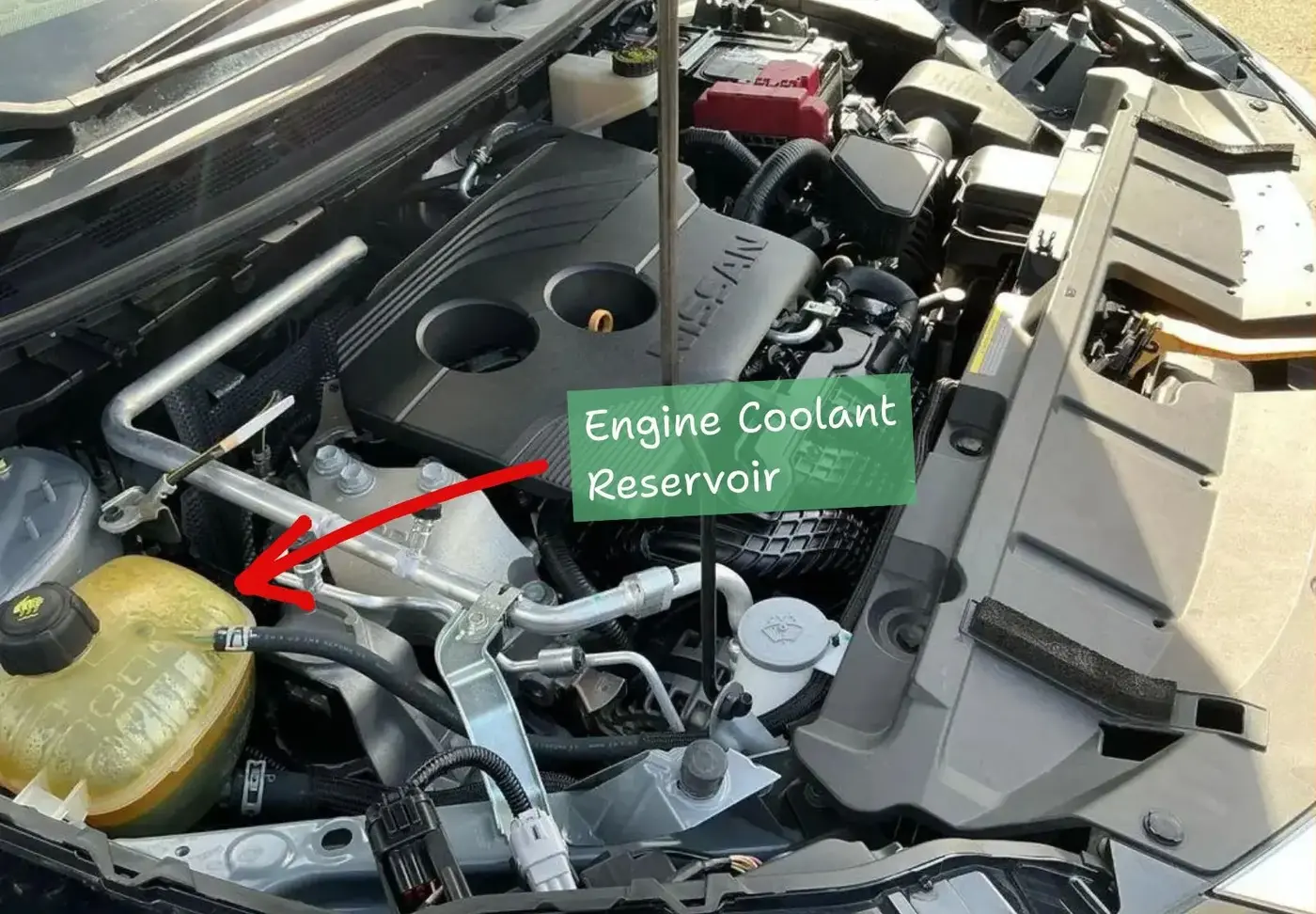
IMPORTANT! To check the coolant level, you don’t need to remove the radiator cap or the reservoir cap. Just check the fluid level in the reservoir.
If you want to check the color of the coolant, feel free to remove the radiator cap or the reservoir cap, but make sure the fluid is cool. To do this, touch the cap; if it feels hot, don’t do it—wait until it’s completely cooled down.
Here are some simple steps to check the coolant:
- Park your Rogue on a level surface and apply the parking brake.
- Open the hood and locate the coolant reservoir (on the left side of the engine).
- Check the side of the reservoir. If it’s dirty, wipe it with a damp cloth so the fluid is visible.
On the side of the reservoir, you’ll see the MIN and MAX marks. You want to make sure the fluid level is between the two. Below the MAX mark and above the MIN mark.
Tips: In my experience, the coolant reservoir on a Rogue can turn yellow and opaque over time. Simply wiping it with a damp cloth isn’t always enough to make the fluid inside clearly visible. Use a flashlight and position it behind the reservoir to see the fluid level clearly.
If you see that the fluid is below the MIN mark, you need to add coolant. After adding coolant, always remember to check the fluid level periodically.
If the fluid level continues to drop, there may be a leak in the cooling system; you should have a mechanic inspect it immediately.
How Often to Change
As I mentioned earlier, it’s important to check the coolant level regularly. In addition to topping it off whenever the level is low, Nissan also recommends performing a complete coolant flush.
This process involves draining all the coolant and replacing it with fresh, new coolant. This replacement is part of the Nissan Rogue standard maintenance schedule.
According to the 2022 Nissan Rogue owner’s manual, page 538, Nissan recommends the first engine coolant change at 105,000 miles (168,000 km) or 84 months. After the first change, replace the engine coolant every 75,000 miles (120,000 km) or 60 months.
Nissan Rogue Coolant Type
Usually, we often see attractive promotions for coolant at the automotive sections of shopping centers like Walmart, Costco, or Target. Although they’re quite tempting, you should think twice before buying them.
That’s because not all coolants are suitable for use in a Nissan Rogue. It’s important to follow Nissan’s recommendations regarding the brand and type of coolant.
In the 2022 Rogue Owner’s Manual, still on page 538, Nissan emphasizes using only Genuine Nissan Long Life Coolant (blue) or an equivalent.
“Equivalent coolant” here refers to a coolant with the proper mixture ratio of 50% antifreeze and 50% distilled water.
Using other types of coolant, mixing different types of coolant, or using mineral water (non-distilled) can reduce the coolant’s lifespan.
Tip: Sometimes you’ll come across “know-it-alls” who claim you can replace coolant with water—stop, don’t believe them, and never do that. True, water can replace coolant, but it doesn’t come without risks—including scale buildup and corrosion in the radiator, which can cause leaks. Coolant isn’t expensive, and the cost is nothing compared to the expense of replacing a leaky radiator caused by using tap water.
Coolant Capacity
Make sure you always fill the coolant reservoir to just below the “MAX” mark. Here is the total capacity based on information from Nissan.
| Model Year | Coolant Capacity |
|---|---|
| 2026 | 9.0 qt (8.5 Liter) |
| 2025 | 9.0 qt (8.5 Liter) |
| 2024 | 9.0 qt (8.5 Liter) |
| 2023 | 2.5L Engine: 9.2 qt (8.8 Liter) 1.5L Turbo Engine: 9.0 qt (8.5 Liter) |
| 2022 | 2.5L Engine: 9.2 qt (8.8 Liter) 1.5L Turbo Engine: 9.0 qt (8.5 Liter) |
| 2021 | 2.5L Engine: 9.2 qt (8.8 Liter) 1.5L Turbo Engine: 9.0 qt (8.5 Liter) |
| 2020 | 7.6 qt (8.1 Liter) |
| 2019 | 7.6 qt (8.1 Liter) |
| 2018 | 7.6 qt (8.1 Liter) |
| 2017 | 7.6 qt (8.1 Liter) |
| 2016 | 7.6 qt (8.1 Liter) |
| 2015 | 7.6 qt (8.1 Liter) |
| 2014 | 7.0 qt (6.7 Liter) |
| 2013 | 7.7 qt (7.3 Liter) |
| 2012 | 7.7 qt (7.3 Liter) |
| 2011 | 7.7 qt (7.3 Liter) |
| 2010 | 7.7 qt (7.3 Liter) |
| 2009 | 7.7 qt (7.3 Liter) |
| 2008 | 7.7 qt (7.3 Liter) |
Intercooler coolant
If you drive a newer Nissan Rogue (2021 model year or later), you should know that there are two coolant reservoirs: one for engine coolant and another for intercooler coolant.
Wait, but what is intercooler coolant?
Intercooler coolant is a coolant used to cool the air in the turbo system. When the turbo compresses the air, it heats up, so the intercooler cools the air before it enters the combustion chamber. Cooler air results in more complete combustion.
So, for those of you driving a Nissan Rogue with a 1.5L VC-Turbo engine, you also need to check the intercooler coolant level; the reservoir is located right next to the engine coolant reservoir.
The 1.5L VC-Turbo engine is highly sensitive to temperature; optimal cooling of the intercooler ensures that engine performance is maintained. That is why it is very important to regularly check the level of the intercooler coolant in addition to the engine coolant.
The checking procedure is the same as for engine coolant. The type of coolant used is also the same.
Does Color Matter?
When shopping for coolant, you might be confused because coolant actually comes in many different colors.
These color differences in coolant actually don’t indicate the presence of any specific active ingredients. Manufacturers produce coolant with certain dyes, typically to make customers believe they must stick to OEM coolant.
All coolants serve the same purpose: preventing water from freezing and boiling, regardless of their color.
However, it is strongly discouraged to mix coolants of different colors. This is because mixing two different colors can shorten the coolant’s lifespan.
Personally, I’ll stick to Nissan’s recommendations; besides, getting Genuine Nissan Long Life Coolant (blue) is quite easy. It’s available at almost all Nissan dealerships.
Common Nissan Rogue Cooling System Problems
Over time, the cooling system may develop issues; while this is rare, here are some common problems found in the Nissan Rogue’s cooling system.
Sweet Smell
If you smell a sweet odor, like maple syrup, after driving, this could be a sign of a small leak, usually at the hose connections or on the radiator.
Leaking coolant will be heated by the high temperatures, causing this smell. Even though the smell is sweet, you shouldn’t ignore it—check the coolant level as often as possible.
I’ve experienced this before, but not with a Nissan Rogue. I had it happen on a motorcycle, and yes, the coolant was leaking.
Air Pockets
When draining and refilling the coolant, there’s a chance that air pockets may get trapped in the system. Air in the system can prevent the cooling process from working properly, leading to overheating.
The solution is to bleed the cooling system. It’s quite simple: just fill the radiator with coolant and leave the radiator cap open, then start the engine and wait for the air bubbles to escape from the radiator. For a detailed guide, watch the video from Cashedoutcars below.
Always perform the bleeding process when the engine is cold to avoid splashes of hot coolant.
Reservoir Leak
The coolant reservoir is made of plastic. Over time, and with the high temperatures in the engine bay, it can develop hairline cracks. These cracks can cause the reservoir to leak; when that happens, you’ll notice drops or a pool of coolant on your garage floor.
Immediately check the bottom of the reservoir for cracks. If you find any, you’ll likely need to replace the reservoir with the new one.
Wrapping Up
Maintaining your coolant is a simple task that requires little effort but has a huge impact. It can help you avoid costly repairs.
By sticking with OEM coolant and keeping the fluid level topped off, your Nissan Rogue’s engine will thank you for years to come.
If you have any further questions or want to discuss anything related to coolant, feel free to leave a comment below!

Tristan has been deep in the automotive world since 2014, long before NissanRogueInfo.com started. His interest in the Rogue actually goes back to high school when he saw a first-gen model modified for off-roading—a moment that stuck with him ever since.
With a Bachelor of Technology and over a decade of professional car journalism under his belt, Tristan doesn’t just write about specs; he’s usually the one under the hood of his own Nissan Rogue or Honda CR-V, figuring out DIY fixes and maintenance tricks. He built this site to share that hands-on experience with other SUV owners who want practical, no-nonsense advice.
One Comment