
Nissan Rogue Payload Capacity Guide (All Model Years)
Thanks to its generous payload capacity, the Nissan Rogue stands out as one of the most versatile compact SUVs on the market. It handles daily driving with ease and is more than capable when it comes to weekend adventures. But just how much can it really carry?
Whether you’re loading up groceries, sports gear, camping supplies, or luggage, knowing your Rogue’s cargo capacity is key for both safety and practicality.
In this guide, I’ll break down the payload capacity for all Nissan Rogue models, explain how to determine the correct weight limit, and share helpful tips to make the most of your SUV’s carrying potential.

What is Payload Capacity?
Payload refers to the total weight your vehicle can safely carry. This includes the driver, passengers, cargo, and anything else you load into or onto your Nissan Rogue, even gear on the roof rack.
Many people mistakenly think payload only refers to the cargo in the trunk, but passengers and any additional items are all part of the equation.
In short, payload capacity is the combined weight your Rogue can handle safely, both inside and on top of the vehicle.
You can usually find a vehicle’s payload capacity in the owner’s manual or on the information label located on the driver-side doorjamb.
However, with the Nissan Rogue, things aren’t that straightforward. After carefully reviewing the owner’s manuals for nearly every model year, I found that Nissan doesn’t directly list the payload capacity.
Instead, Nissan recommends checking the GVWR (Gross Vehicle Weight Rating) and the curb weight, which are printed on the label inside the driver’s door.
Unfortunately, there’s no clear or direct payload figure provided — so you’ll need to do a little math.
To calculate your Rogue’s payload capacity, subtract the curb weight from the GVWR.

For example, if the GVWR is 5,000 pounds and the curb weight is 4,000 pounds, then the payload capacity is 1,000 pounds.
View Nissan Rogue Payload Capacity by Model Year
Since Nissan doesn’t provide clear payload capacity information in the owner’s manual, you’ll need to calculate it yourself.
To save you time and effort, I’ve already done the work. I gathered the GVWR and curb weight data for all model years and trim levels of the Nissan Rogue, then calculated the payload capacity for each one — so you don’t have to.
Select the model year of your Nissan Rogue below to view the payload capacity details specific to that year.
2025 Nissan Rogue Payload Capacity
| Model | Payload Capacity |
|---|---|
| 2025 Nissan Rogue S | 1.164 lbs |
| 2025 Nissan Rogue S AWD | 1.166 lbs |
| 2025 Nissan Rogue SV | 1.111 lbs |
| 2025 Nissan Rogue SV AWD | 1.116 lbs |
| 2025 Nissan Rogue SL | 1.076 lbs |
| 2025 Nissan Rogue SL AWD | 1.079 lbs |
| 2025 Nissan Rogue Platinum | 1.038 lbs |
| 2025 Nissan Rogue Platinum AWD | 1.036 lbs |
| 2025 Nissan Rogue Rock Creek | 972 lbs |
2024 Nissan Rogue Payload Capacity
| Model | Payload Capacity |
|---|---|
| 2024 Nissan Rogue S | 1.164 lbs |
| 2024 Nissan Rogue S AWD | 1.149 lbs |
| 2024 Nissan Rogue SV | 1.023 lbs |
| 2024 Nissan Rogue SV AWD | 1.028 lbs |
| 2024 Nissan Rogue SL | 986 lbs |
| 2024 Nissan Rogue SL AWD | 988 lbs |
| 2024 Nissan Rogue Platinum | 926 lbs |
| 2024 Nissan Rogue Platinum AWD | 946 lbs |
2023 Nissan Rogue Payload Capacity
| Model | Payload Capacity |
|---|---|
| 2023 Nissan Rogue S | 1.164 lbs |
| 2023 Nissan Rogue S AWD | 1.107 lbs |
| 2023 Nissan Rogue SV | 1.063 lbs |
| 2023 Nissan Rogue SV AWD | 1.069 lbs |
| 2023 Nissan Rogue SL | 984 lbs |
| 2023 Nissan Rogue SL AWD | 990 lbs |
| 2023 Nissan Rogue Platinum | 966 lbs |
| 2023 Nissan Rogue Platinum AWD | 944 lbs |
2022 Nissan Rogue Payload Capacity
| Model | Payload Capacity |
|---|---|
| 2022 Nissan Rogue S | 1.164 lbs |
| 2022 Nissan Rogue S AWD | 1.107 lbs |
| 2022 Nissan Rogue SV | 1.063 lbs |
| 2022 Nissan Rogue SV AWD | 1.069 lbs |
| 2022 Nissan Rogue SL | 984 lbs |
| 2022 Nissan Rogue SL AWD | 990 lbs |
| 2022 Nissan Rogue Platinum | 966 lbs |
| 2022 Nissan Rogue Platinum AWD | 944 lbs |
2021 Nissan Rogue Payload Capacity
| Model | Payload Capacity |
|---|---|
| 2021 Nissan Rogue S | 1.164 lbs |
| 2021 Nissan Rogue S AWD | 1.107 lbs |
| 2021 Nissan Rogue SV | 1.075 lbs |
| 2021 Nissan Rogue SV AWD | 954 lbs |
| 2021 Nissan Rogue SL | 1.129 lbs |
| 2021 Nissan Rogue SL AWD | 1.006 lbs |
| 2021 Nissan Rogue Platinum | 1.107 lbs |
| 2021 Nissan Rogue Platinum AWD | 986 lbs |
2020 Nissan Rogue Payload Capacity
| Model | Payload Capacity |
|---|---|
| 2020 Nissan Rogue S | 1.164 lbs |
| 2020 Nissan Rogue S AWD | 1.130 lbs |
| 2020 Nissan Rogue SV | 1.102 lbs |
| 2020 Nissan Rogue SV AWD | 1.106 lbs |
| 2020 Nissan Rogue SL | 1.039 lbs |
| 2020 Nissan Rogue SL AWD | 1.050 lbs |
2019 Nissan Rogue Payload Capacity
| Model | Payload Capacity |
|---|---|
| 2019 Nissan Rogue S | 1.164 lbs |
| 2019 Nissan Rogue S AWD | 1.137 lbs |
| 2019 Nissan Rogue SV | 1.102 lbs |
| 2019 Nissan Rogue SV AWD | 1.106 lbs |
| 2019 Nissan Rogue SV Hybrid | 1.054 lbs |
| 2019 Nissan Rogue SV Hybrid AWD | 1.028 lbs |
| 2019 Nissan Rogue SL | 1.041 lbs |
| 2019 Nissan Rogue SL AWD | 1.052 lbs |
| 2019 Nissan Rogue SL Hybrid | 1.037 lbs |
| 2019 Nissan Rogue SL Hybrid AWD | 1.017 lbs |
2018 Nissan Rogue Payload Capacity
| Model | Payload Capacity |
|---|---|
| 2018 Nissan Rogue S | 1.164 lbs |
| 2018 Nissan Rogue S AWD | 1.140 lbs |
| 2018 Nissan Rogue SV | 1.102 lbs |
| 2018 Nissan Rogue SV AWD | 1.106 lbs |
| 2018 Nissan Rogue SV Hybrid | 1.057 lbs |
| 2018 Nissan Rogue SV Hybrid AWD | 1.031 lbs |
| 2018 Nissan Rogue SL | 1.049 lbs |
| 2018 Nissan Rogue SL AWD | 1.061 lbs |
| 2018 Nissan Rogue SL Hybrid | 1.003 lbs |
| 2018 Nissan Rogue SL Hybrid AWD | 997 lbs |
2017 Nissan Rogue Payload Capacity
| Model | Payload Capacity |
|---|---|
| 2017 Nissan Rogue S | 1.065 lbs |
| 2017 Nissan Rogue S AWD | 1.124 lbs |
| 2017 Nissan Rogue SV | 1.048 lbs |
| 2017 Nissan Rogue SV AWD | 1.107 lbs |
| 2017 Nissan Rogue SV Hybrid | 1.096 lbs |
| 2017 Nissan Rogue SV Hybrid AWD | 1.069 lbs |
| 2017 Nissan Rogue SL | 984 lbs |
| 2017 Nissan Rogue SL AWD | 1.051 lbs |
| 2017 Nissan Rogue SL Hybrid | 1.027 lbs |
| 2017 Nissan Rogue SL Hybrid AWD | 1.001 lbs |
2016 Nissan Rogue Payload Capacity
| Model | Payload Capacity |
|---|---|
| 2016 Nissan Rogue S | 1.164 lbs |
| 2016 Nissan Rogue S AWD | 1.131 lbs |
| 2016 Nissan Rogue SV | 1.067 lbs |
| 2016 Nissan Rogue SV AWD | 1.124 lbs |
| 2016 Nissan Rogue SL | 997 lbs |
| 2016 Nissan Rogue SL AWD | 1.060 lbs |
2015 Nissan Rogue Payload Capacity
| Model | Payload Capacity |
|---|---|
| 2015 Nissan Rogue S | 1.096 lbs |
| 2015 Nissan Rogue S AWD | 1.147 lbs |
| 2015 Nissan Rogue SV | 1.076 lbs |
| 2015 Nissan Rogue SV AWD | 1.133 lbs |
| 2015 Nissan Rogue SL | 1.008 lbs |
| 2015 Nissan Rogue SL AWD | 1.073 lbs |
2014 Nissan Rogue Payload Capacity
| Model | Payload Capacity |
|---|---|
| 2014 Nissan Rogue S | 1.096 lbs |
| 2014 Nissan Rogue S AWD | 1.147 lbs |
| 2014 Nissan Rogue SV | 1.076 lbs |
| 2014 Nissan Rogue SV AWD | 1.133 lbs |
| 2014 Nissan Rogue SL | 1.008 lbs |
| 2014 Nissan Rogue SL AWD | 1.073 lbs |
2013 Nissan Rogue Payload Capacity
| Model | Payload Capacity |
|---|---|
| 2013 Nissan Rogue S | 1.063 lbs |
| 2013 Nissan Rogue S AWD | 1.098 lbs |
| 2013 Nissan Rogue SV | 1.010 lbs |
| 2013 Nissan Rogue SV AWD | 1.047 lbs |
| 2013 Nissan Rogue SL | * |
| 2013 Nissan Rogue SL AWD | * |
2012 Nissan Rogue Payload Capacity
| Model | Payload Capacity |
|---|---|
| 2012 Nissan Rogue S | 1.063 lbs |
| 2012 Nissan Rogue S AWD | 1.098 lbs |
| 2012 Nissan Rogue SV | 1.010 lbs |
| 2012Nissan Rogue SV AWD | 1.047 lbs |
2011 Nissan Rogue Payload Capacity
| Model | Payload Capacity |
|---|---|
| 2011 Nissan Rogue S | 1.063 lbs |
| 2011 Nissan Rogue S AWD | 1.098 lbs |
| 2011 Nissan Rogue SV | 1.010 lbs |
| 2011 Nissan Rogue SV AWD | 1.047 lbs |
| 2011 Nissan Rogue S Krom Edition | 1.163 lbs |
| 2011 Nissan Rogue S Krom Edition AWD | 1.098 lbs |
2010 Nissan Rogue Payload Capacity
| Model | Payload Capacity |
|---|---|
| 2010 Nissan Rogue S | 1.046 lbs |
| 2010 Nissan Rogue S AWD | 1.069 lbs |
| 2010 Nissan Rogue SL | 973 lbs |
| 2010 Nissan Rogue SL AWD | 970 lbs |
| 2010 Nissan Rogue S Krom Edition | 1.046 lbs |
| 2010 Nissan Rogue S Krom Edition AWD | 1.069 lbs |
2009 Nissan Rogue Payload Capacity
| Model | Payload Capacity |
|---|---|
| 2009 Nissan Rogue S | 1.046 lbs |
| 2009 Nissan Rogue S AWD | 1.069 lbs |
| 2009 Nissan Rogue SL | 973 lbs |
| 2009 Nissan Rogue SL AWD | 970 lbs |
2008 Nissan Rogue Payload Capacity
| Model | Payload Capacity |
|---|---|
| 2008 Nissan Rogue S | 966 lbs |
| 2008 Nissan Rogue S AWD | 965 lbs |
| 2008 Nissan Rogue SL | 1.040 lbs |
| 2008 Nissan Rogue SL AWD | 1.066 lbs |
The Risks of Overloading Your Nissan Rogue
Carrying too much weight can increase the risk of both safety issues and vehicle damage. Here are some of the potential problems:
- Reduced handling and stability
- Less effective braking
- Poor fuel efficiency
- Higher chance of mechanical failures
- Faster tire wear or even blowouts
- Increased risk of rollover, especially at higher speeds
- Legal Issues
Determine the Correct Load Limit
The risks we just covered are reason enough to avoid overloading your vehicle. But that brings up an important question — how do you know how much stuff your Nissan Rogue can actually carry?
According to the Nissan Rogue owner’s manual, there are a few simple steps you can follow to figure out the correct load limit.
Here’s how to do it:
- Find your Rogue’s maximum payload capacity: You can locate this on the “Tire and Loading Information” label inside the driver’s side door (if available), or simply refer to the table provided above.
- Add up the weight of all passengers: Include the driver and everyone who will be riding in the vehicle.
- Subtract the total passenger weight from the payload capacity. This will give you the remaining capacity for your cargo.
- Use the result as your cargo limit The final number is how much weight you can safely carry in luggage, gear, or other items.
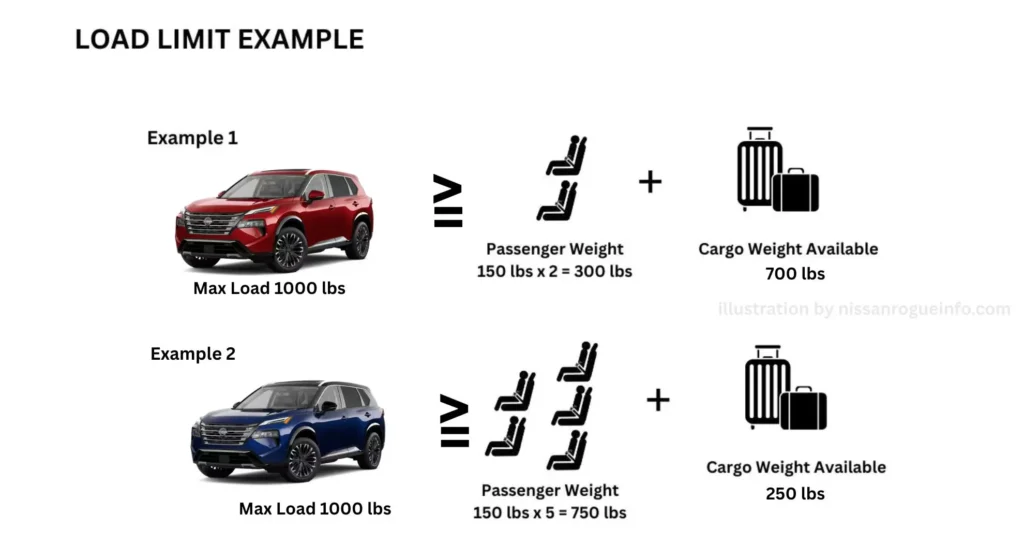
Example:
If your Nissan Rogue has a maximum load capacity of 1,000 lbs and you have five passengers who each weigh 150 lbs:
1,000 lbs – (5 × 150 lbs) = 250 lbs
So, you have 250 lbs available for cargo and luggage. Staying within this limit helps keep your drive safe and your vehicle in good condition.
Here’s an illustration I created to help you better understand how to determine your Nissan Rogue’s load limit.
How to Increase Payload Capacity
Boosting the payload capacity of your Nissan Rogue isn’t exactly easy — there’s no magic button to press.
That said, with a bit of effort and some creative thinking, you can squeeze out a little extra capacity.
One method I’ve used is removing the front passenger seat. When I needed to haul bulky items, taking out the seat gave me more room and helped reduce the overall weight, making room for more cargo.
You can also remove the spare tire, which usually frees up around 30 pounds. But keep in mind, this option is only practical for short trips. If you’re going on a long journey, it’s best to keep the spare — better safe than stranded.
If removing the passenger seat still doesn’t give you enough load capacity, then it might be time to consider a more practical solution. Here are a couple of options:
- Use a utility trailer: The Nissan Rogue has a towing capacity that allows it to haul a small utility trailer with up to 1,500 pounds of cargo. It’s a great way to carry extra gear without overloading your vehicle.
- Rent a more suitable vehicle: If your hauling needs go beyond what the Rogue can carry or tow, renting a larger or more capable vehicle is the smarter choice. Pushing your Rogue past its limits can lead to serious safety issues and long-term damage.
By going with one of these alternatives, you help ensure a safer, more efficient trip when heavy loads are involved.
Final Words
By understanding your Nissan Rogue’s cargo capacity, you can better estimate how much gear you can safely carry—an important step toward safer, more responsible driving.
To make things easier, I’ve spent a few days gathering and calculating the load capacity for various Nissan Rogue models and trim levels, so you don’t have to.
Just remember: always stay within the recommended limits to keep your ride smooth and safe.
If you have any questions or want to share your own experience, feel free to drop them in the comments!



One Comment